

Our Research
Advancing Actionable Science for Nature-Based Solutions
NPAC’s research is designed to move beyond theory and directly inform real-world action. By working in partnership with municipalities, conservation organizations, and government agencies, the center co-develops projects that test, evaluate, and refine nature-based solutions in practice. Through supporting decision-making with the best available science, our work improves conservation, restoration, and climate adaptation planning that benefits biodiversity and people.
NPAC helps partners monitor and evaluate solutions over time, adapt strategies based on evidence, and scale successful approaches across regions. By linking scientific insight with on-the-ground application, the center accelerates the transition from knowledge to impact.
Our collaborative approach ensures that research becomes a foundation for implementation rather than an endpoint.
Core Research Areas
-
![Illustration of a hand in a peach color, spreading outward in multiple directions against a black background.]()
Quantifying the Diverse Values of Nature
///
We develop innovative approaches to monitor and evaluate the diverse values of nature at scale because “we manage what we can measure.” These values include nature’s contribution to people (e.g. ecosystem services of carbon and water), biodiversity, cultural values, and other community benefits. This work ensures that conservation, climate adaptation, nature market’s and other management strategies are effective, accountable, and continuously improving.
-
![Close-up of a stack of wavy, layered, light brown and dark brown wooden or cork material slices with black edges.]()
Attribution of Biodiversity Change
///
We develop and apply advanced technologies for monitoring biodiversity change using new big data streams from remote sensing and participatory science. To go beyond documenting biodiversity trends, we are leading the application of cutting-edge approaches for impact evaluation to evaluate the drivers of biodiversity and outcomes from conservation.
-
![Graphic design of a stylized hand with lines radiating outward on a black background.]()
Adaptive Management for Nature and People
///
We bring decision tools to support adaptive management – iterative learning while implementing – for conservation and restoration strategies that enhance biodiversity while helping ecosystems and communities adapt to climate change. We focus on navigating uncertainty and learning about multi-objective solutions that balance ecological integrity with human needs.
-
![An illustration of a black cat with large pinkish-brown toes on its paws, sitting on its hind legs with front paws resting on the ground.]()
Ecosystem-Based Climate Risk, Mitigation, and Adaptation
///
We investigate how climate change and extreme events impact ecosystems and the services they provide to people. We help end-users measure the outcomes of nature-based solutions, including projects targeting climate adaptation and mitigation, using the best available approaches for impact evaluation, evidence synthesis, and causal inference. This work helps inform the design of nature-based solutions that are resilient under changing environmental conditions.




Featured Project
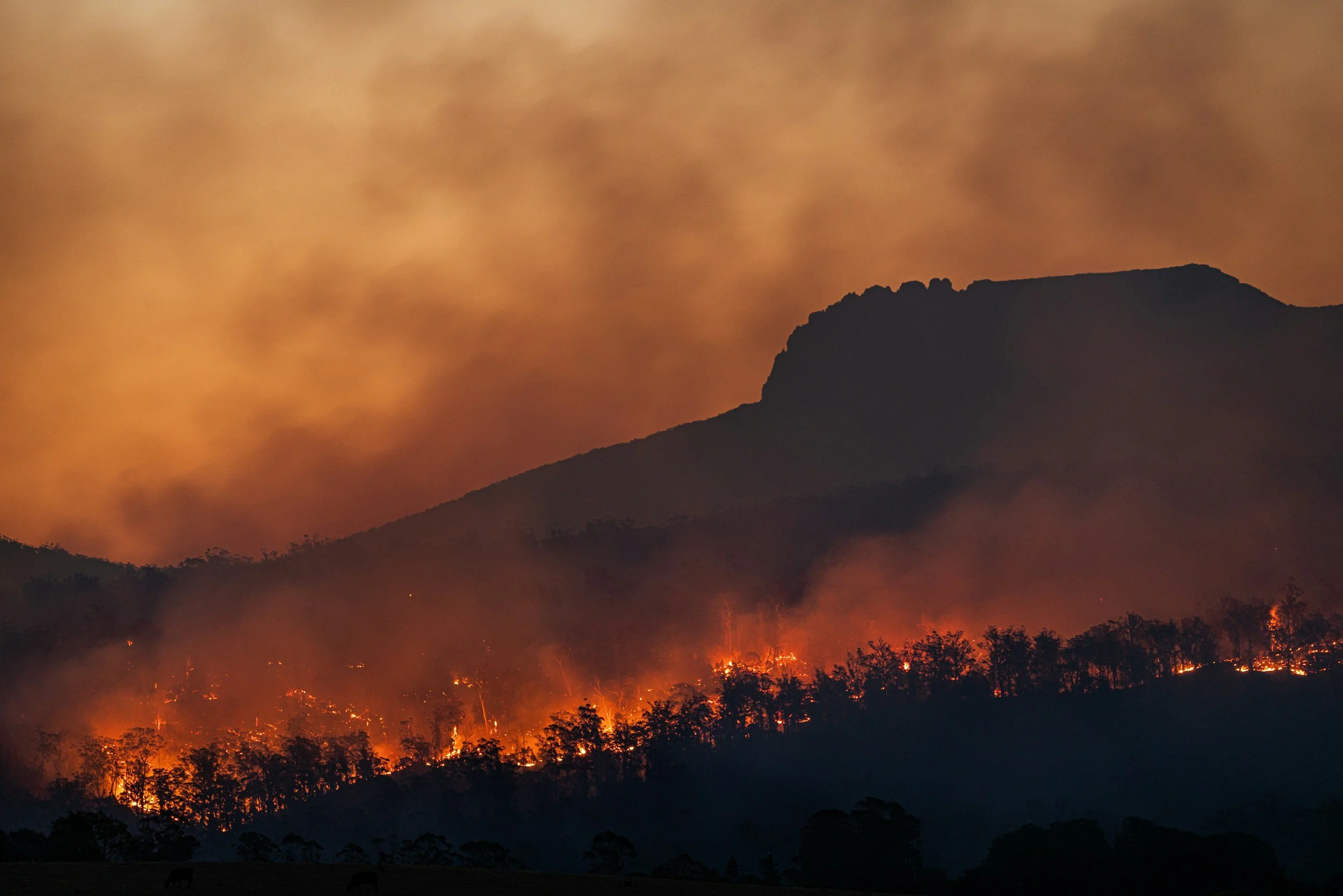
The Impacts of Prescribed Fire in California and Colorado on Ecosystem Services
Increasing wildfire severity and frequency in the Western US are escalating social, ecological, and economic risks. Prescribed burning – the intentional application of fire to the landscape to achieve management goals – is a key adaptation strategy to reduce risks from wildfire; however, monitoring and evaluating effectiveness of prescribed burning – particularly as a multi-objective management tool -- remains a challenge.
We currently lack large-scale knowledge of how prescribed fire mitigates the potential impacts of wildfire on multiple values from ecosystems, beyond only fire risk reduction. A major barrier to this evidence is that current models of ecosystem services do not consider events like fire. In response, we are quantifying and communicating the impacts of prescribed fire versus wildfire in carbon storage, recreation, and water yield in Colorado and California. Working with partners such as Tall Timbers, Colorado Department of Nature Resources, and the US Forest Service, the results from this work will be used to identify co-benefits and tradeoffs from prescribed burning across multiple ecosystem benefits by informing where, when, and for whom prescribed burning is effective.
This research was funded through the Morpho Initiative at the National Center for Ecological Analysis and Synthesis (NCEAS) and NASA and led by NPAC researchers.


Featured Project
Tracking Nature-Positive Progress Across Cities in the Contiguous United States
Recent local-to-global policies and initiatives have focused on integrating nature-positive practices - activities encompassing biodiversity conservation, aimed at halting and reversing nature loss - into city planning frameworks.
To meet biodiversity goals at the subnational scale, the Berlin Urban Nature Pact aims to downscale global biodiversity targets specifically in cities. Monitoring changes in nature-positive practices is a key factor to ensure that cities are increasing or maintaining nature-positive practices and for tracking progress towards global policy frameworks like the Berlin Urban Nature Pact. While there are numerous initiatives that outline indicators, cities still face challenges and constraints that limit the ability to effectively monitor and track progress through time:
Measuring the many indicators that are currently proposed is costly
Choosing indicators is difficult given the number of options available
Indicators that are not standardized make comparison across cities difficult
This project works to overcome these challenges by creating an open-source reproducible workflow that can be applied at a national level to track the progress of seven dimensions of nature-positive practices. Our group then applies our workflow to over 4,000 cities in the contiguous United States to evaluate the status of these nature-positive indicators.
This project is led by a visiting graduate student from Nanchang University in collaboration with the City of Boulder Climate Initiative Team and researchers at NPAC.